Undertale
I’ve reviewed five video games in nineteen years of blogging, and it’s been seven since the last one, so we’re overdue for another. Back in July a couple friends of mine suggested that I try out Undertale. I knew next-to-nothing about the game, but since I have some free time now and it was on sale anyway, I decided to give it a shot.
As a fair warning to readers who haven’t played the game yet, even more so than most games, Undertale is best played blind. For about the first half of this post I’ll talk about the aesthetics and mechanics with only very light spoilers, but I’ll get into flagrant plot spoilers after that. I will give a warning, but if you’re just interested in whether I recommend it or not, I suppose I’d give it three stars out of four, and as long as you’re open to the game’s aesthetics and genres (RPG and bullet hell), you’ll likely enjoy it. Besides, it’s short and inexpensive, so you have little to lose.
One last caveat before we get to the review: I’ve played a lot of games in my life, but almost all of them were between the ages of five and eighteen. By the 2010’s (Undertale came out in 2015), I was playing only sporadically. My most recent game purchase before this was UnReal World in 2021. So, I feel like I can review this game objectively, but I’m not exactly up on the latest in gaming trends or anything, even as of 2015.
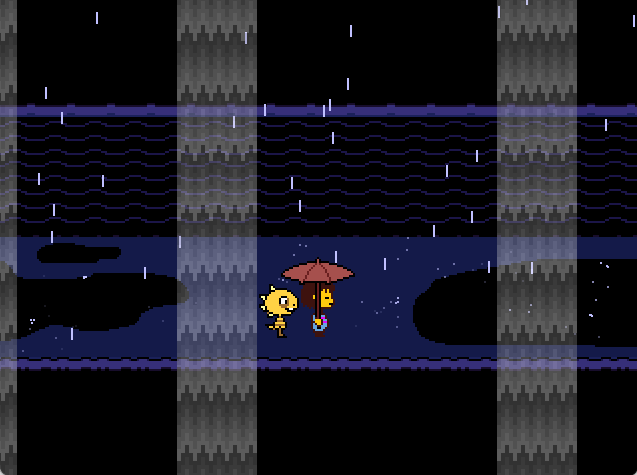
Let’s go on this adventure together
Anyway, on to the game. The overall aesthetic is a faux-retro style. I can imagine some of the game’s assets scaled down for a release on the NES, or scaled up for the Super NES. Some of the music could probably even work on a Game Boy, though most of it is more reminiscent of the Super NES. Character designs have this quirky look to them that I’m unsure how to describe, but the designs (and much of the humour and writing, for that matter) feel very online, very Millennial-coded to me. I could see it being off-putting for some people, but as for me, I am a very online Millennial, so this hole was made for me, I guess.
Almost the only thing I knew about Undertale before playing was that it had a reputation for excellent music, and indeed, the soundtrack has one banger after another. Developer Toby Fox (who made the game almost entirely solo) clearly took a lot of inspiration from early-’90s RPGs, with a generous side of Touhou. One part of the game even includes a spoof of the great opera scene from Final Fantasy VI, complete with that uniquely SNES sound effect that FFVI used to imitate human voices. I’m aware of versions of these songs played on real instruments, but personally, the electronic sound is a big part of the charm, even outside the immediate context of the game.
As for the gameplay, there are quite a few puzzles throughout, most similar to what you’d find in the 2D Legend of Zelda dungeons. They peak at about moderate difficulty, which I appreciate because I don’t really care for puzzles in general. As for combat, at a glance it fits neatly into the classic RPG format. You can Fight, Act, use an Item, Spare an enemy, or Flee. Fighting depends on properly timing a button press when a moving cursor is right over a target. It’s unusual for an RPG, but not totally unique. In Super Mario RPG, for instance, your attacks could do bonus damage if you properly timed a button press.
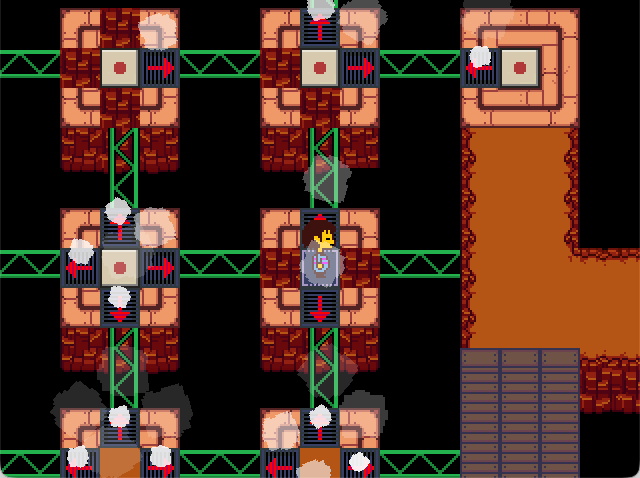
Moderate meaning this late-game puzzle took me ten minutes of bouncing around to solve
Enemy attacks are in a bullet hell format, similar to the Touhou games. Mercifully, they’re significantly easier than Touhou, so maybe “bullet purgatory” is more accurate. Most of the game’s challenge comes from this mechanic, and again, I’d say it peaks at moderate difficulty. A few of the boss fights took me multiple tries, but even the hardest boss, Asgore, I beat in five attempts. As someone who’s degenerated into a filthy casual, this is fine with me, but people who play action-oriented games frequently can probably breeze through most of the game.
Items and equipment are mostly typical RPG fare. One minor nuisance is that you’re limited in how much you can carry, so you have to store extra items in these magic boxes that appear around the world. However, there isn’t one near the end, so what happened to me is that I stored the butterscotch pie to save for the end since it’s a powerful item, but didn’t have it available when I finally got to the last few bosses and had to backtrack to retrieve it.
Undertale’s most unusual mechanics are the Act and Spare options. Essentially, you have the option to spare enemies by wearing them down to a point where they no longer want to fight. One way to do that is to fight them down to low health, like you’d do before trying to catch a Pokémon. The other way is to use the Act menu. The commands available vary widely depending on the enemy, but include things like Talk, Compliment, Threaten, Pray, Mystify, Pet, and even Flirt, among many others. You can use the Check option to get some basic information about enemies, which typically gives you some clue to what Act commands are most effective, but determining which ones to use and in which order is largely a matter of trial and error. It’s like an extension of talking to enemies in the Shin Megami Tensei games, which is apparently what inspired Fox, except that you can use it with practically every enemy. It’s really neat, and one of Undertale’s highlights.
You’ll know that an enemy can be spared, by the way, when his name text changes from white to yellow, and the NPC who explains this is clear about that, but as we’ll see, the game isn’t quite 100% consistent about this.
For those who care, plot spoilers begin below!
So, early on, I expected the tone of the story to be bleak. Your first encounter is with Flowey, who calls you an idiot for trusting him and tells you that it’s kill or be killed in this world, and you’re only saved by Toriel’s intervention. Some early NPCs urge you not to kill anyone, which made me think that mercy must be the exception and not the rule in this setting, and Toriel is very concerned about your safety.
This made Toriel’s house seem like a moment of respite in what was going to be a harsh world, and it felt genuinely cozy. Honestly, this was the highlight of the game for me. I loved the details around her house that emphasised how motherly Toriel is, like the supplies of toys and shoes (but what happened to the shoes’ former owners, I wondered!), or how the edges of the fireplace tools had been blunted.
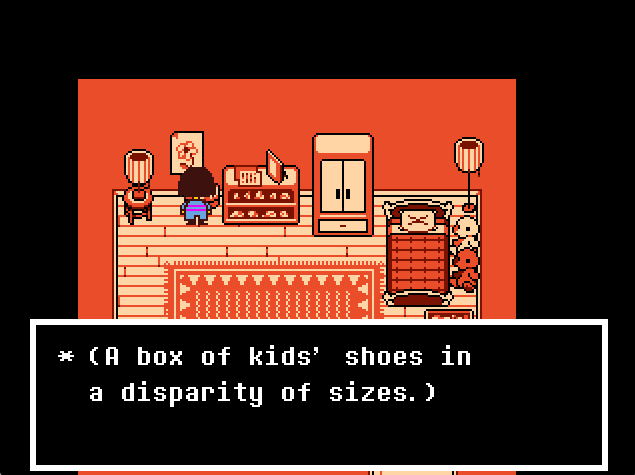
Shoes
Shortly after leaving her house, though, we run into two of the problems I have with Undertale. During the fight with Toriel, it’s made clear that talking isn’t effective, and her name never turns yellow, so obviously, per the game’s rules plainly set out minutes earlier, sparing isn’t an option in this fight. However, that isn’t true. I looked this up after finishing the game, and in fact, if you choose Spare several times, it eventually works! Perhaps I missed a hint somewhere, but learning this was very irritating. Because I’d assumed killing Toriel was my only option, I was locked out of getting a good ending (I wound up with the “neutral” ending, which isn’t all bad, but still amounts to a “you suck” ending).
In any case, after this tense scene in what seems like a grim story, you go outside and meet Sans and Papyrus. Now, I like these characters, and they have some genuinely funny jokes. However, they’re also a couple goofballs, and reading through Sans’s puns right after the Toriel fight felt like tonal whiplash. We then proceed to Snowdin Town. I assumed this was going to be like visiting Zozo, where everyone is out to get me. After all, the monsters are stuck down here because of a war with us humans, and their king wants to kill me – but no. Everybody here is very chill, and seems perfectly fine with a human walking around freely. Apparently, Flowey is just a lone psychopath in this world. Not only is it not “kill or be killed,” but nobody actually wants to fight me at all, aside from him, Mettaton, and Undyne, and you can befriend Undyne. Everyone else fights only reluctantly and can be convinced to stop.
Near the end of the game, you’re asked if you would like to go home or stay and suffer with the monsters, but really, what suffering? If I didn’t have much going on at home, sure, I’d happily stay and hang out in Snowdin Town or live with Toriel. Heck, I’d rather live in even the Ruins than Detroit. Snowdin Town is definitely no worse than the average suburb.
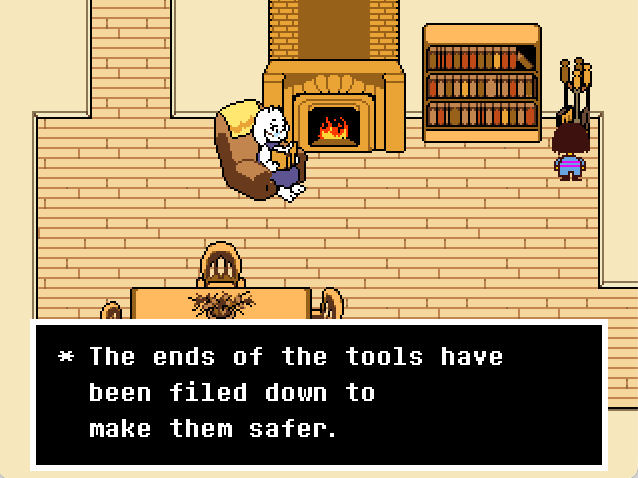
Looks cozy to me
After that initial whiplash, the game’s tone does mostly even out, though not entirely. The sadness of Asgore’s backstory is well done. It’s nothing mind-blowing, but it’s touching and effective despite clashing with the goofiness of characters like Mettaton. I’ll also say that stories about parent/child relationships hit harder after having my own family.
The biggest narrative problem is Flowey breaking the fourth wall at the end. The fight against Omega Flowey itself is a bit annoying, but his explicitly talking about things like taking over your saved game file completely throws me out of the story and reminds me that this is just a game and doesn’t actually matter. I remember being blown away by this kind of gimmick when fighting Psycho Mantis in Metal Gear Solid, but at the time it was more novel and did less harm to the player’s immersion in the story since it was in the middle and not at the very end.
Essentially, Undertale feels like a silly, self-conscious game with a serious story underneath, and the two don’t quite cohere as well as I wish they did.
One more thing about Flowey, at the very end you’re given the choice to fight or spare him. I incorrectly assumed this would affect the ending and that you’re “supposed” to spare him, but I decided to fight anyway, because some people monsters need killing.
After finishing the game, I spent some time reading up on it and found that there’s quite a bit of backstory that you only learn on subsequent playthroughs. Some of it is a little interesting, but most feels superfluous. I’m not sure that Alphys’s experiments add a lot to the story or themes, and Flowey’s origin isn’t substantially more compelling to me than him just being a psychopath. I’m glad I didn’t try to be a completionist for this.
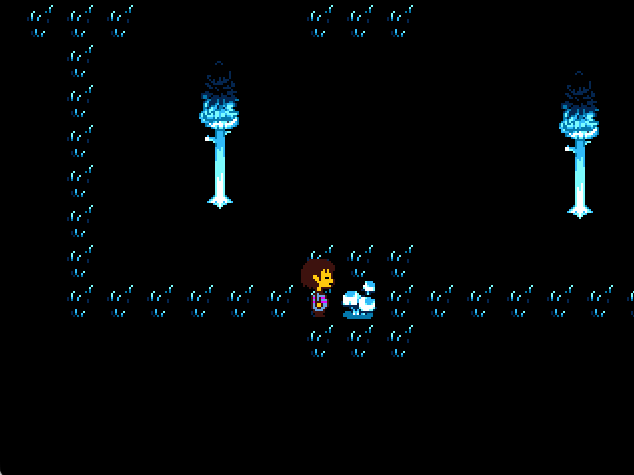
One of the game’s most memorable settings
Alphys was a pretty good character, easy to relate to for the socially anxious nerds in the audience (“but that just is the audience!” -Statler and Waldorf). Mettaton reveals that she was the one who created many of the puzzles you encounter, and she did so to feel important in helping you pass them. The puzzles were too easy for that to have much impact, though. I can’t be too mad at her creating obstacles that took me five minutes to overcome. Papyrus’s puzzles were also easy, but that’s treated as a joke.
I didn’t play through the date with Alphys; the date with Papyrus was already tedious and unfunny, so it didn’t feel worthwhile.
I felt like I disliked Mettaton while playing, but in hindsight he’s almost the most memorable character for me, and the last fight with him really drew me in. So, hats off to Toby Fox for making a strong villain.
My favourite enemy character was Muffet. This was the first fight that took me multiple attempts to beat and may have been the most fun for me. Part of me wishes I found her less cute.
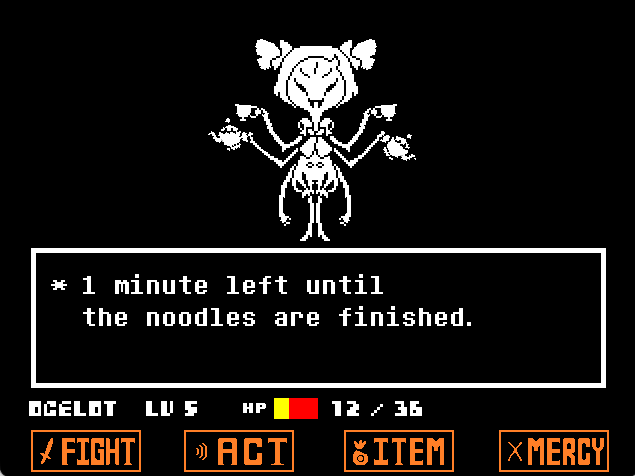
Yeah, I took the time to make instant noodles during the fight
In the neutral ending I got, you’re told that Undyne wants to invade the human world. This is supposed to sound threatening, but lady, for real: how? The monsters already lost a war against humans once, and a human child just cut through all of you like a hot knife through butter. Just stay home.
I think that’s absolutely everything I have to say about the game. I’m very glad my friends recommended it to me, because in spite of a couple flaws keeping it from greatness, I enjoyed it a lot. Literature will certainly remain my primary hobby; the only other game I see myself playing in the near future is a train simulator I bought during Steam’s summer sale because I thought my son might enjoy it. However, playing through Undertale did put me in a nostalgic mood and reminded me of how engaging this medium is. I realise this isn’t an original insight, but it is remarkable how solid gameplay contributes to making the player feel fully invested in a game’s story and setting, even when that story isn’t high art – and Undertale, to its great credit, is a better story than probably 90% of the novels out there.