Impressions

How to Read a Book (75 Books - IX)

I’ve heard of Mortimer Adler and Charles van Doren’s How to Read a Book here and there before, but decided to give it a read after seeing Henry Dampier’s review of it, and thinking that it may be useful, especially since I’m trying to read more (and maybe even read better) this year.

Unfortunately, I didn’t find the book as helpful as I thought I might, though that’s not really the fault of the authors. My main problem is simply that I’m already doing some of the things they suggest, e.g.  “inspectional” reading, skim- or pre-reading, or taking notes. The reminders don’t hurt, and I did pick up a few things, but I didn’t really need 336 pages of it, either.
75 Books in 2015 - VI (In Praise of Shadows)

Tanizaki Junichiro’s In Praise of Shadows is ostensibly a book-length essay in defense of traditional Japanese aesthetics, especially in architecture. He doesn’t really present a formal argument, though; instead, he presents a series of ruminations and anecdotes on topics loosely related to the main idea of the importance of shadows, darkness, and quiet in Japanese architecture. The book reminds me of taking a short, meandering walk with someone through their garden, as they relate some story of each place you come across. Some subjects include cuisine, noh and kabuki theatre, restaurant lighting, and toilets. I found this style interesting, even persuasive, but it may be the sort of “argument” that you either get or you don’t.

75 Books in 2015 - V (A Bride's Story vol. 6)

It just occurred to me that I should’ve used the title “Bibliophile’s Journal” for this series, since this is almost exactly what I originally had in mind for the posts already using that title. I suppose I could go back and change it - there are only five entries so far.

Also: Once again I’m able to post two days in a row. My blagging prowess grows by the day.

75 Books in 2015 - IV (The Habsburg Monarchy, 1809-1918)

Alright, we’re not even half a month into this challenge, and we’re bangin’ on all cylinders. My fourth completed book of the year is The Habsburg Monarchy, 1809-1918, by A.J.P. Taylor.

Now, I’m the sort of person who can’t help but feel a fondness for the Habsburgs, but I don’t feel confident that I know enough about them, so this book was a good step in correcting that. Well, somewhat, at least - because it focuses on 1809 onwards, much of it only covers one Habsburg, Franz Joseph, who reigned from 1848-1916. Furthermore, the book is actually fairly depressing, as it covers the decline and fall of the Austrian empire. There are very few triumphs here, and there’s a lot of muddling along and compromising, trying to hold the empire together for as long as possible, yet knowing that things cannot go on forever. Indeed, if the empire hadn’t been necessary to maintain stability in this part of Europe and thus been handled with kid-gloves by its neighbours, it may well have collapsed earlier than it did. As Taylor put it, “Austria was preserved to suit the convenience of others, not by her own strength. A Great Power becomes a European necessity only when it is in decline; the truly great do not need to justify their existence.”

75 Books in 2015 - II and III (Spice & Wolf)

When was the last time I managed to post on consecutive days? For that matter, when was the last time I posted on consecutive weeks?

Also, how should I format post titles? Heck if I know.

Anyway, I can knock out graphic novels pretty quickly, as evidenced by getting through volumes nine and ten of Koume Keito’s adaptation of Spice & Wolf. The first thing I noticed about these volumes is that I had totally forgotten what was going on in the plot at this point; such are the dangers of letting so much time pass between reading installments of an ongoing story. Confusing things further is that it seems to be a little past where I am in the original novels (vol. 6), but Koume also makes a few changes here and there.

75 Books in 2015 - I (Iron Kingdom)

As I mentioned in the 2014 year-end post, I’m going to make an attempt at this challenge at LibraryThing to read 75 books in 2015. You can find my specific thread here, but I’ll also be sharing my progress on this weblog and use the thread mostly as a means of “officially” entering the challenge and to talk with any other LibraryThing members who care to stop by. I won’t be doing full reviews of these books; in most cases I’ll probably just share a few things I liked or didn’t, maybe a notable passage or two, and whether I recommend it or not.

A Decade's Worth of Serial Experiments

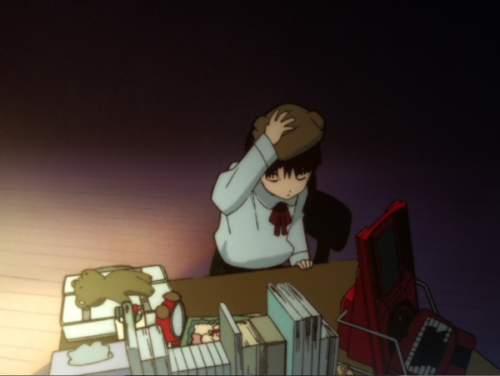
This post was written with my bear cap on.

This post was written with my bear cap on.

I got my first job in late October 2004; it was only as a temporary hire for a one-week special event, but for me that first pay cheque was an absolute fortune. I don’t remember what all I got with it, but do remember the one thing that mattered - a copy of serial experiments lain, which I count as my first anime.

Uncle Walt-a-thon: The Jungle Book

<- Uncle Walt-a-thon: Sword in the Stone

It gives me a little sense of pride that mine must be one of the few blogs that can post a review of The Jungle Book right after a post on Doctor Zhivago, and it’s not even out-of-place.

Anyway, I already wrote up a closer for this series, but I did want to include The Jungle Book since it was the last film Disney worked on (though he passed away while it was still in production). Also, it was likely my favourite film as a child. I couldn’t even guess how many times I watched this movie before I turned ten, but it was enough that, even though I haven’t seen it in a solid decade-and-a-half, I could still remember every scene, almost every line, even. Only Robin Hood and Winnie the Pooh and the Blustery Day are even in the same ballpark for my favourite and most-watched childhood films.

Doctor Zhivago

You know a movie’s going to be good when it opens with an overture. I’ve actually not seen any other films that have one (though a few people on twitter have informed me that it used to be fairly common for old film epics), but I knew it was a promising start to this latest film about Soviet-induced misery, Doctor Zhivago.

Unlike the last two installments, which were either obscure (The Chekist) or at least not very well-known in the United States (Katyn), Zhivago is one of the better-known Hollywood epics, and “epic” is just the right word for it - with a wide-ranging plot and a run-time of three hours and twenty minutes, it’s a project just to watch. Fortunately, though, it doesn’t feel that long; the pacing if fairly quick, and it never dwells on a particular scene for very long. It’s also a visually interesting film, with a variety of settings and some unusual camerawork (e.g., following a character by looking in through outside windows). A bit distractingly, one can also play a game of “place the accent;” it has a mix of American and British actors, a couple French minor characters, and a couple guys who do a Russian accent, which is rather confusing.

The Bibliophile's Journal IX: The Crystal Comes Back

Yep, going back to subtitles for this monthly - hey, remember when Bibliophile’s Journal was going to be a monthly series? Well, we just skipped a month or ten. No big deal.

Anyway, I’ve read a few things in the past month or so, so let’s bring the journal back.

First up, Alex Cross, Run by James Patterson, and Rules of Prey by John Sandford. Alex Cross was loaned to me by my boss, Rules by a co-worker. I’m fifty pages into the second and it’s tolerable; I finished the first and it sucks. Our hero, Alex Cross, perfectly fits the cliché of the “good cop,” so if you’ve seen most any B-grade crime movie or TV show, you’ve met this character. The villains are one-dimensional and more evil than Satan; Patterson tries to add some shock value by making their crimes perverse and adding some sexual tension between the two men, but it comes across as what an eighth-grader would write if asked to produce a “shocking” crime novel.