Frankenstein (Actually, it's Ito Junji's Monster)
When I pick up a story by prolific horror artist Ito Junji, there are two things I expect: It’s gonna be good, and it’s gonna be gross. There are a few exceptions at least to the latter point, but his adaptation of Frankenstein delivers on both fronts. If you’re looking for a manga to read for Halloween but want something more classic than Uzumaki or Gyo, this will be a solid choice.
Since comics are a visual medium let’s start with the art. Every panel is filled with detail, and the heavy linework and monochrome colour make the whole story feel appropriately dark and uneasy. Panel layouts are effective throughout the work, and the design of the monster is excellent. Perhaps this sentiment comes from reading it so recently, but thinking through other designs for Frankenstein’s monster, like the 1931 film or Hammer’s movie series among many others, this may be my favourite. He looks appropriately terrifying and obviously stitched-together, but also strong and agile as he is in the novel. I was less excited by the human characters, who all look good but not particularly special. I suppose that’s fine, though, since Frankenstein is best kept relatively realistic to aid suspension of disbelief, so wild character designs aside from the monster may call too much attention to themselves.
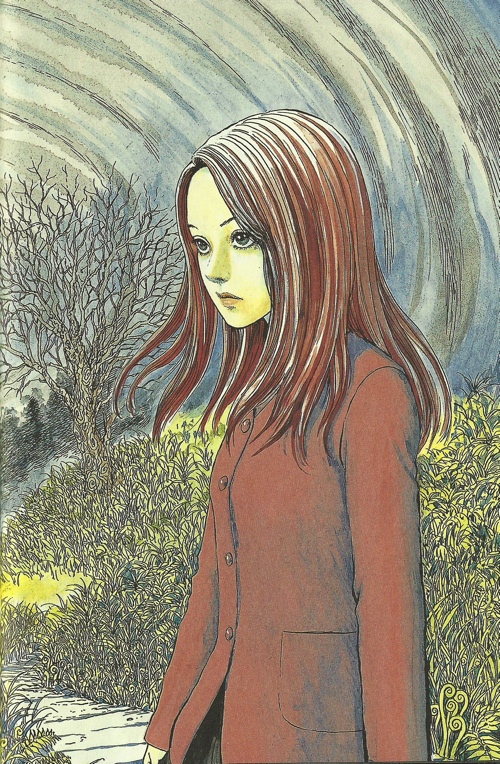 I’ll give Uzumaki this: I’ve never seen anything quite like it. Author Ito Junji’s concept sounds like one hell of a creative writing challenge: the town of Kurouzu-cho is cursed by spirals. Every chapter repeats the “spiral” motif somehow, and though some episodes succeed more than others, I have to tip my hat to Ito just because he could write a three-volume comic using such an odd hook.