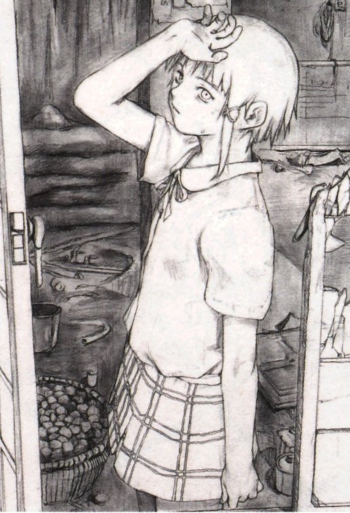
Serial Experiments Lain

Psyche

Ready for more serial experiments lain? In Layer 03: Psyche the beginning voice-over tells us “There’s a girl named Lain. You may have heard of her. She’s on the Wired.” The episode proper begins at a police station, where an officer is questioning Lain about the incident at Cyberia. He tells her that no one at her house has answered the phone, and sh isn’t sure why. When she does get home, no one is there and it seems almost too neat, like a hotel room. Alice apologises to Lain, and the next day at school the girls are talking oddly lightly about what had happened, which Alice later points out as rather strange, considering that a man killed himself right in front of them.

Girls

Let’s continue to the next episode of serial experiments lain. Layer 02: Girls begins with another invitation from a voice-over on the Tokyo cityscape, “What is it you’re so afraid of? Why don’t you take a chance some time?” We’re then introduced to the Cyberia night club, where we see a guy buying and taking a drug called Accela, about which we get our first infodump later in the episode, as well as our first glimpse of Lain of the Wired. Alice and her friends see this alternate Lain and ask the real-world Lain if it was her, but she has no idea what they’re talking about. Alice, friendly girl that she is, invites Lain to join them at Cyberia that night, which takes some prodding. We also see one of the men in black for the first time. Lain’s new Navi is delivered, and she asks her father to set it up right away. At Cyberia, the Accela addict shoots up the place, but Lain confronts him and he kills himself.

Weird

In Tokyo, Japan, at the present day and present time, a middle school student commits suicide by jumping off a building. Soon after, her classmates receive an e-mail from someone claiming to be her.

“I didn’t die,” she tells them. “I’ve merely abandoned the flesh…. Do you understand? It’s okay if you can’t right now. You will all understand soon. Everyone will. God is here.”

So begins serial experiments lain, which debuted on Japanese television on this day in 1998. I first saw the anime back in 2004 and have rewatched it many times since then; every time I revisit lain I fear that I’ll start noticing more shortcomings, that the novelty of this strange series will wear off, that it’ll be overshadowed by something else – yet, that’s never happened. I gave it another viewing to prepare for its twentieth anniversary, and I still admire it.

A Decade's Worth of Serial Experiments

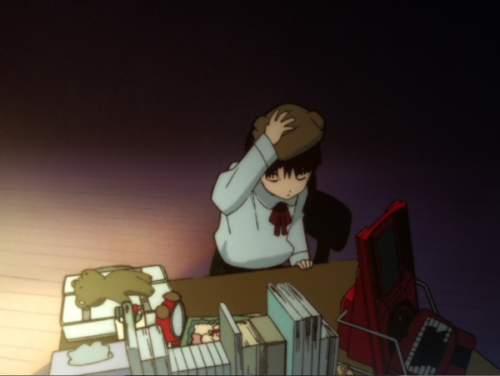
This post was written with my bear cap on.

This post was written with my bear cap on.

I got my first job in late October 2004; it was only as a temporary hire for a one-week special event, but for me that first pay cheque was an absolute fortune. I don’t remember what all I got with it, but do remember the one thing that mattered - a copy of serial experiments lain, which I count as my first anime.

Wired Theology: Godhood in Serial Experiments Lain

I mentioned last week that one thing I like about serial experiments lain is how many ideas it incorporates, or at least references, throughout the show. Most of these relate to technology and man’s relationship with technology, but since a major element of the plot involves a (self-proclaimed) god, it does touch on a couple theological issues as well. Since the show itself doesn’t delve into these very deeply, though, I thought I’d put together a few thoughts about what it does say.

Serial Experiments Lain on Glorious Blu-Ray

As I mentioned in the second Anime Autobiography post, serial experiments lain is, by far, my favourite anime, and the show that really made me into an anime fan. So, when Funimation finally, two years after licensing it, released it on glorious blu-ray I felt obligated to pre-order it.

Now, I’ll focus on this specific release rather than the series itself for this post, but I will say that what I love about lain is the show’s ambition. Writer Konaka Chiaki and his co-creators really packed a lot of ideas into this show, and the result is a series dense with information. There’s a good deal of exposition and a few infodumps, and though the generally slow pacing keeps this from getting totally out of hand, it is fair to use one of the episode titles, “infornography,” to describe this show’s approach to storytelling. If you want to know a little more about the show itself, I’d recommend reading Lawrence Eng’s short review (his site, “thought experiments lain,” is also a great resource for information on the show’s many allusions and plot points).

Anime Autobiography - In the Modern Fashion

<– Previous: Anime Autobiography - Endless Delinquency and Despair

In 2010, my university career ended with a whimper, and I entered the “real world.” Actually, I just continued at the job I already had and spent most of the next year or so wondering what to do for a career. It was a somewhat depressing time, in a way, but hey - I still had my Japanese cartoons.

Now, at this point I’d seen enough that fewer and fewer shows offered really new experiences for me. Most of the shows I saw in 2010-11 stood out because they excelled at something that I’d already seen elsewhere. I also find it difficult to say much about some of these shows because they’re so recent that I can’t quite contextualise them yet. After reflecting on how to go about sharing my experience from these years, it occurred to me that the most significant event is probably a shift in how I watched anime. So here we go - how I watch anime in a modern fashion.

Anime Autobiography - serial experiments lain

<– Previous: Anime Autobiography - Pokemon and Spirited Away

Though I had already seen Pokemon and Spirited Away, I would consider serial experiments lain my ‘first’ anime, because it was the first show I sought out because it was anime. In October 2004, I worked my first job as a one-week temporary employee, for which I received the seemingly massive sum of around $350. I don’t remember what else I purchased with that bounty, but one of my first priorities was lain, which I think I ordered from Half.com (and which, I learned a couple years later, was bootleg!).