Literature

Le Misanthrope (75 Books - XV)

I’m afraid I won’t have much to say on this one, for a few reasons:

  1. Wi-fi router problems mean I’m writing on a smartphone right now. Bad times.
  2. I read this largely out of a sense of duty because of Molière’s reputation. The premise isn’t very appealing to me (my edition calls the play a “comedy of manners”).
  3. Plays are meant to be performed, not read. My favourite Shakespeare play is Richard III, and my favourite play overall is Marlowe’s Dr. Faustus. Not coincidentally, these are two of the only ones I’ve seen performed live.
  4. I read this partly as a way to practice my French. I found that, though I understood most of the words okay, following the sense of everything was difficult. This is a student edition, and I relied more heavily than I’d like on the annotations and summaries. No surprise that 17th century French is more difficult than, say, Chihayafuru, but I’d always thought of vocabulary as my biggest linguistic obstacle; I’ve now run into something new.

So, I’ve found myself in a two-book slump, though in neither case would I blame the author. My next book, besides continuing with Watamote, is a return to history with Diplomacy, by Henry Kissinger.
The Picture of Dorian Gray (75 Books - XIII)

Another audiobook, this time Oscar Wilde’s The Picture of Dorian Gray, published by Blackstone Audio and narrated by Simon Vance.

Now, when I wrote about Murakami Haruki’s Kafka on the Shore, I criticised the author for being too eager to show off how intelligent he is by name-dropping famous musicians and such at every opportunity. Wilde goes much farther, as a large part of the novel consists of long conversations that don’t seem to have much purpose beyond giving Wilde an opportunity to show the reader how clever he is, or filling a chapter describing the various musical or gemstone collections his protagonist acquires and making sure we all know how much research he did in the lore of these things. To be fair, Wilde is genuinely clever, and his dialogues are often amusing, but they make the novel longer than necessary and quickly begin to feel tedious.

What's the Appeal of Mishima Yukio?

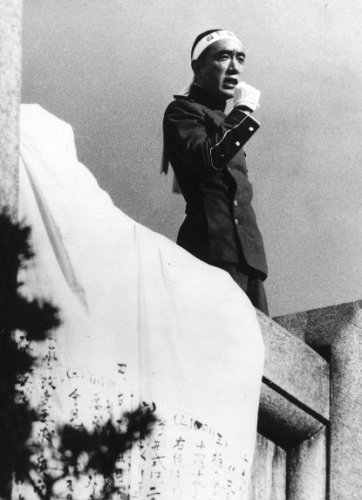
SFA222007830A while back, while visiting a friend of mine, I mentioned having recently re-watched Paul Schrader’s fascinating biographical film Mishima: A Life in Four Chapters. He had never heard of Mishima Yukio, and after explaining that he’s famous as one of Japan’s greatest novelists and infamous for committing suicide in spectacular fashion in 1970, he asked why I had such obvious admiration for a man who committed suicide, which, being a faithful Catholic, I consider to be an inherently evil action.

Kafka on the Shore (75 Books - X)

The one benefit of having a very long commute to work each day is that it allows one to get through a lot of audiobooks and podcasts. Not that I actually listen to a lot of audiobooks, admittedly, mainly because I like to mark up my books and share interesting passages on twitter as I go. They do benefit from professional narration, though, like a radio play, and poetry especially benefits from being read out loud. Of course, audiobooks are also a distraction while driving, though if I do get into an auto accident at least I’ll go out listening to something good.

How to Read a Book (75 Books - IX)

I’ve heard of Mortimer Adler and Charles van Doren’s How to Read a Book here and there before, but decided to give it a read after seeing Henry Dampier’s review of it, and thinking that it may be useful, especially since I’m trying to read more (and maybe even read better) this year.

Unfortunately, I didn’t find the book as helpful as I thought I might, though that’s not really the fault of the authors. My main problem is simply that I’m already doing some of the things they suggest, e.g.  “inspectional” reading, skim- or pre-reading, or taking notes. The reminders don’t hurt, and I did pick up a few things, but I didn’t really need 336 pages of it, either.

The Bibliophile's Journal IX: The Crystal Comes Back

Yep, going back to subtitles for this monthly - hey, remember when Bibliophile’s Journal was going to be a monthly series? Well, we just skipped a month or ten. No big deal.

Anyway, I’ve read a few things in the past month or so, so let’s bring the journal back.

First up, Alex Cross, Run by James Patterson, and Rules of Prey by John Sandford. Alex Cross was loaned to me by my boss, Rules by a co-worker. I’m fifty pages into the second and it’s tolerable; I finished the first and it sucks. Our hero, Alex Cross, perfectly fits the cliché of the “good cop,” so if you’ve seen most any B-grade crime movie or TV show, you’ve met this character. The villains are one-dimensional and more evil than Satan; Patterson tries to add some shock value by making their crimes perverse and adding some sexual tension between the two men, but it comes across as what an eighth-grader would write if asked to produce a “shocking” crime novel.

Bram Stoker's Dracula Is Surprisingly Boring

Once in a while, I come across a work of fiction that should be better than it is, and unfortunately Bram Stoker’s Dracula fits firmly into that category. The premise carries the novel through, and the story does have some strong points, but Stoker does a couple of things that undermine the whole work.

The first major problem is that Stoker wrote this as an epistolary novel. I believe this style used to be much more common than it is now, but was already long past its prime when Stoker wrote Dracula, and good riddance. Ideally, the epistolary style adds a sense of realism, making the reader feel like he’s a researcher going through primary documents, rather than reading an artificially constructed narrative. Since much of Dracula is essentially a mystery story, this approach does serve the plot well. However, I found the constant changes in narrator, and the changes in tone, setting, and style that accompanied that, distracting, and it made the novel more difficult to get into. Also, the epistolary style doesn’t do as good a job of conveying action as a basic third-person narration, and overall the novel may have been better if Stoker had simply used the third-person omniscient narrator.

The Bibliophile's Journal VIII

Yeah, dropping the post subtitling thing after one week. Maybe next time, if I think of something good.

Anyway, this past month may mark the beginning of a change in the way I read books, since I’ve subscribed to Audible. I’ve listened to a handful of audiobooks in the past, and though I don’t like them nearly as much as sitting down and reading through a physical book I decided to give this a try since I often find myself listening to podcasts while, say, cooking or working out. I don’t actually follow many podcasts, though, but audiobooks seem like a logical step. Besides, I don’t get through as many books as I’d like, and this should help with that.

The Bibliophile's Journal VII: Advent Children

Yeah, I’m classing it down this time with a rather silly subtitle. Couldn’t resist, for some reason.

Anyway, as you may guess from my last few posts I’m back to my usual self, devouring one book after another. Of course, there’s always a trade-off, so recently I’ve been watching fewer anime and movies than usual. There are several interesting-looking shows coming up this season, though, so perhaps my reading schedule will collapse again in a week or two. In the meantime, besides Haruhi and The Sea, here’s what I’ve been reading lately:

Associations of The Dissociation of Haruhi Suzumiya

The American release of Tanigawa Nagaru’s Haruhi Suzumiya novels are in the home stretch, with the recent release of The Dissociation of Haruhi Suzumiya. It’s the first of a two-part story, to be concluded in the next and last novel, so I’ll hold off on a full review. There were, however, a few things I found interesting with this one.

The most obvious feature of this novel is that the narrative splits halfway through, and what occurs over the next few days differs significantly between the two versions. Though there is some overlap between the two, the differences aren’t subtle like, say, the “Endless Eight” story arc from a few volumes back. I don’t see any hint as to how these two parallel timelines may relate to each other, except that Kyon, our intrepid narrator, does mention not having encountered a slider yet near the beginning of the book. Is it time for one to finally appear?